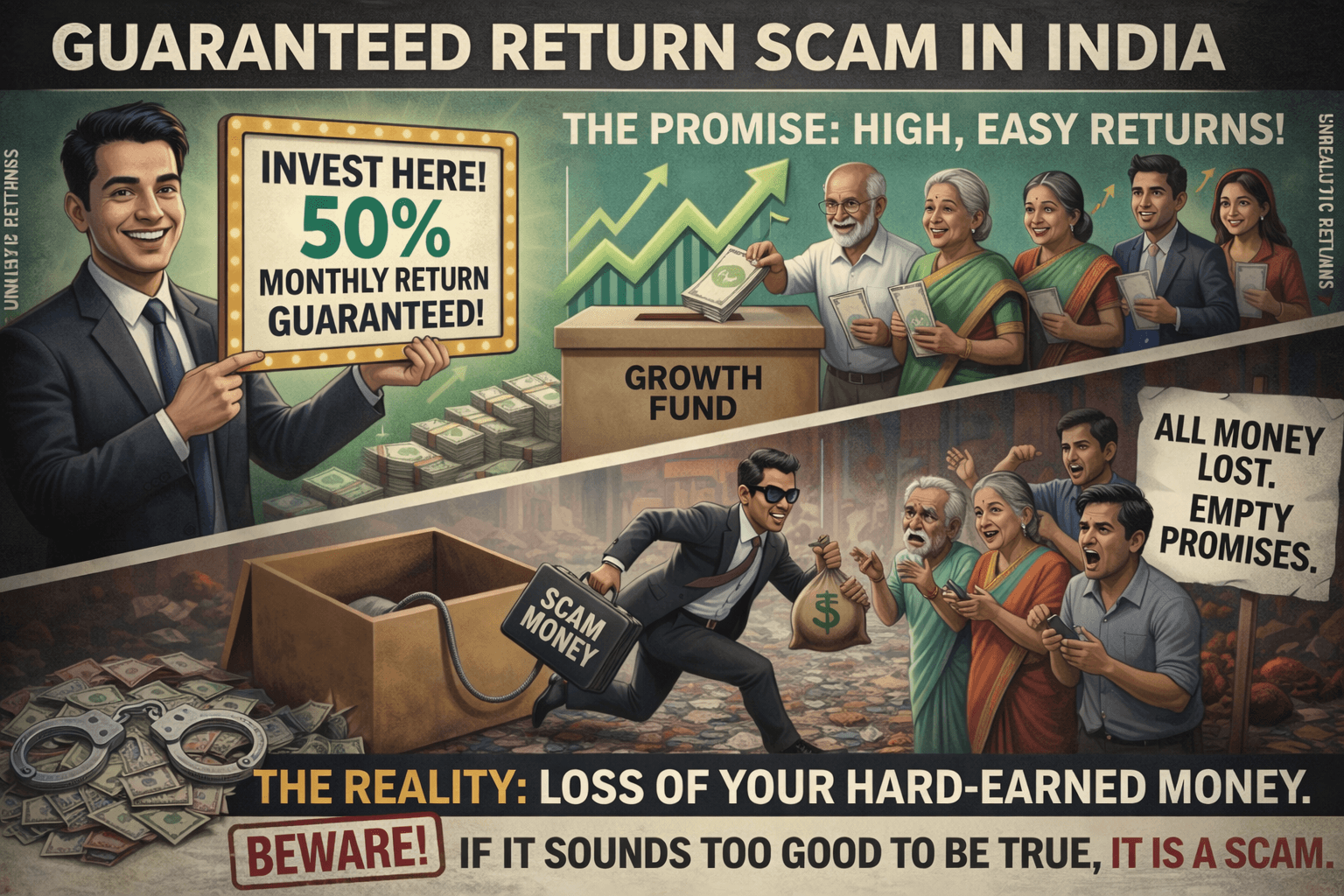
How Investors Are Trapped with “Assured Profit” Promises
Introduction
One of the most common financial scams in India today is the Guaranteed Return Scam. These scams usually target people who want to earn quick money from the stock market, cryptocurrency, forex trading, IPO investments, or online investment schemes. The scammers attract victims by promising fixed or guaranteed returns with low risk, which is something that does not exist in real financial markets.
Many people fall into this trap because the offer sounds attractive, the communication looks professional, and the scammers often claim to be experts, advisors, company representatives, or investment managers. By the time victims realize the truth, they have already transferred large amounts of money.
Understanding how guaranteed return scams work is very important to avoid financial loss.
The Biggest Lie in Financial Markets – Guaranteed Returns
Before understanding the scam, it is important to understand one basic rule of finance:
No one in the stock market, crypto market, forex market, or any investment market can legally or genuinely guarantee profits.
Markets always involve risk. Returns can be positive or negative depending on market conditions. Any person or company promising fixed profits or guaranteed returns is either misleading or running a scam.
Common fake promises used in these scams:
- Guaranteed monthly returns
- Fixed daily income from trading
- No risk investment plan
- Loss recovery guarantee
- Double money scheme
- Assured IPO allotment profit
- Safe trading with fixed return
- 100% accuracy trading signals
- Profit sharing plan with guaranteed profit
These promises are the first red flag.
How Guaranteed Return Scams Usually Start
The scam usually begins through online contact. Victims are contacted through:
- WhatsApp messages
- Telegram groups
- Instagram ads
- Facebook ads
- YouTube comments
- Dating apps
- Random phone calls
- Investment websites
- Fake trading apps
The scammer introduces themselves as:
- Investment advisor
- Portfolio manager
- Stock market expert
- Crypto trader
- Forex trader
- IPO specialist
- Fund manager
- Algo trading company
- Research analyst
- SEBI registered advisor (sometimes fake, sometimes misused)
They speak professionally and try to build trust slowly.
The Trust Building Stage
Before asking for money, scammers spend time building trust. They may:
- Share profit screenshots
- Show fake trading reports
- Show fake client profits
- Add you to WhatsApp or Telegram group
- Show other people making profit (fake messages)
- Provide small free profit calls
- Send professional-looking documents
- Show fake company registration
- Show fake SEBI certificate
- Show fake website or app
This stage is designed to make the victim believe that the investment opportunity is genuine.
The Investment Stage – Money Transfer Begins
Once trust is built, the scammer asks the victim to invest money. They may say:
- Start with small investment
- Minimum investment required
- Special opportunity available
- Limited seats for investment plan
- IPO investment opportunity
- Crypto investment opportunity
- Forex trading investment
- Guaranteed profit trading account
- Managed trading account
- Double money plan
- High return bond
- Pre-IPO investment
- Private placement investment
The victim is asked to transfer money through:
- Bank transfer
- UPI
- Wallet transfer
- Crypto transfer
- Fake trading app deposit
- Payment gateway
- Personal bank account
- Third-party account
This is where the financial loss starts.
Fake Profits and Dashboard Manipulation
In many scams, after the victim deposits money, the scammer shows fake profits through:
- Fake trading app
- Fake investment website
- Fake account dashboard
- Edited profit screenshots
- Fake account balance
- Fake profit statements
The victim sees their money growing and believes the investment is genuine. This encourages them to invest more money.
This is called “Profit Display Scam” — profits are shown but money cannot be withdrawn.
Withdrawal Trap
When the victim tries to withdraw money, scammers create new charges such as:
- Withdrawal fee
- Tax clearance fee
- Processing fee
- Account upgrade fee
- Security deposit
- RBI clearance fee
- GST payment
- International transfer fee
- Margin maintenance fee
- Conversion charges
- Penalty charges
The victim is told that withdrawal will be processed after paying these charges.
After paying these charges, scammers ask for more charges again. This continues until the victim stops paying.
Finally, the scammer stops responding completely.
Loss Recovery Scam After Guaranteed Return Scam
Sometimes after the victim loses money, another person contacts them and says:
- We will recover your lost money
- We are from recovery department
- We are from cyber crime
- We are from RBI
- We are from investment recovery company
- Pay recovery charges and we will recover money
This is called a Recovery Scam, and many victims lose even more money here.
Psychology Behind Guaranteed Return Scams
These scams work because scammers understand human psychology very well.
They use:
- Greed → High profit promise
- Trust → Professional communication
- Authority → Fake certificates
- Social proof → Fake group profits
- Urgency → Limited opportunity
- Fear → Opportunity miss ho jayegi
- Hope → Loss recover ho jayega
- Dependency → Advisor pe depend ho jao
Victims do not lose money because they are foolish.
They lose money because scammers manipulate emotions and trust.
Major Warning Signs of Guaranteed Return Scam
Always be careful if someone:
- Guarantees profit
- Promises fixed return
- Says no risk investment
- Shows only profit screenshots
- Pressures to invest quickly
- Asks money in personal account
- Uses WhatsApp or Telegram only
- Does not provide official agreement
- Asks withdrawal charges
- Shows fake app or website
- Offers loss recovery plan
- Says double money scheme
- Says 100% accuracy trading signals
If multiple of these signs are present, it is most likely a scam.
How to Protect Yourself from Guaranteed Return Scams
To stay safe:
- Never believe guaranteed return promises
- Verify company registration
- Verify SEBI registration on official website
- Do not transfer money to personal accounts
- Avoid unknown investment apps
- Do not pay withdrawal charges
- Do not share OTP or login details
- Always research before investing
- Avoid investment through WhatsApp or Telegram
- Understand that high return = high risk
- Learn basic investment knowledge
- Take investment decisions yourself
The safest investment rule is:
If someone guarantees profit, stay away.
What To Do If You Are a Victim of Guaranteed Return Scam
If you have already lost money:
- Stop sending more money immediately
- Save all chats and emails
- Save payment receipts and bank statements
- Take screenshots of investment dashboard
- Note phone numbers and bank accounts used
- File complaint on Cyber Crime Portal
https://cybercrime.gov.in - Inform your bank immediately
- File complaint on SEBI SCORES if related to investment advisor
- Keep all evidence safely
- Act quickly because delay reduces recovery chances
Final Conclusion
Guaranteed return scams are successful because they target people’s desire to earn easy money with low risk. In reality, there is no investment in the world that provides guaranteed high returns without risk.
The biggest rule of investing is simple:
Higher Return = Higher Risk
No Risk = No High Return
Guaranteed High Return = Scam
Always remember:
“Market me profit kamana mushkil hai,
lekin guaranteed profit dene wale log milna bahut aasaan hai.”
Stay aware, stay informed, and never trust guaranteed return promises.

Written by
admin