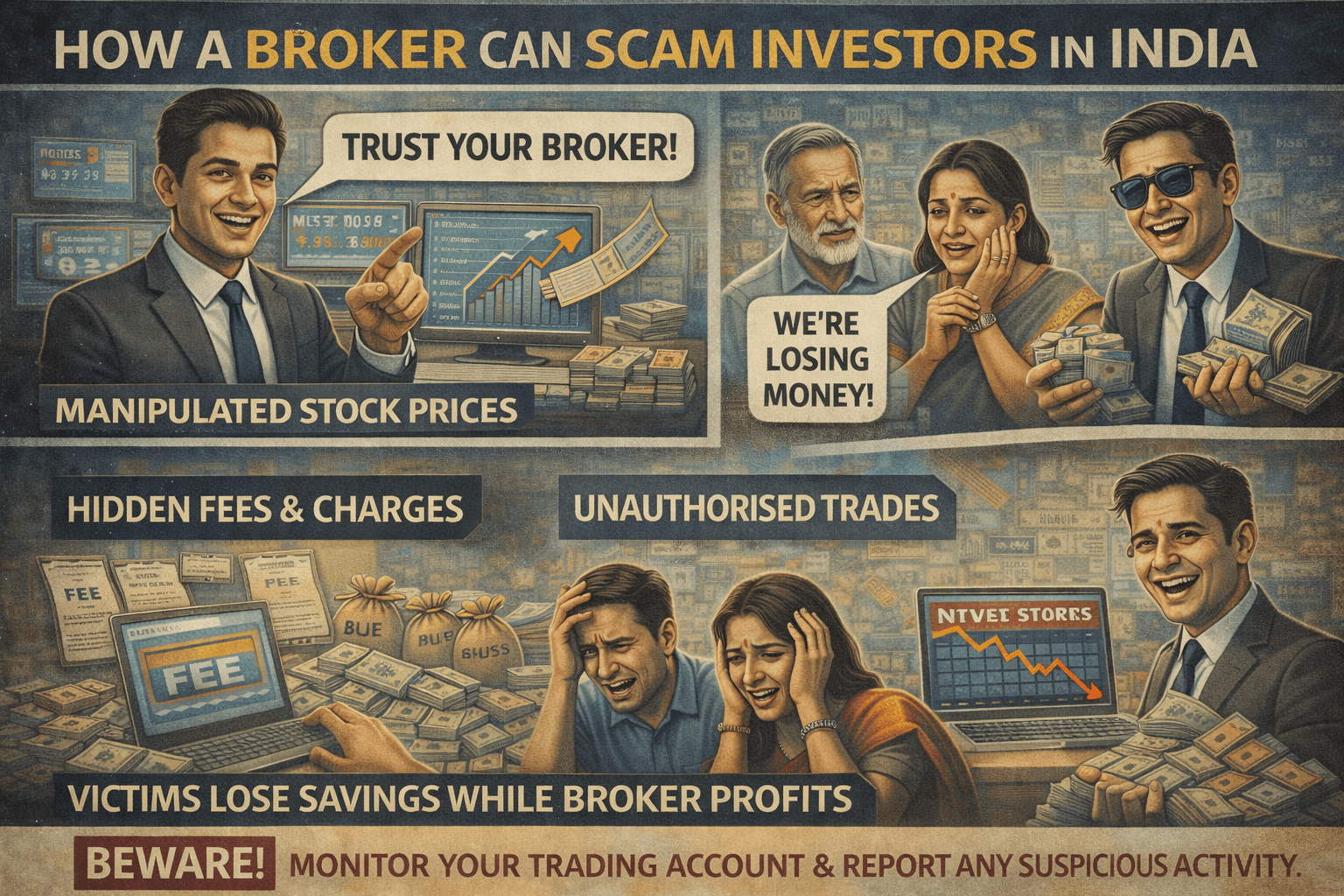
Detailed Explanation of Broker Misconduct, Tactics, and Protection
Introduction
In India, stock brokers play a critical role in enabling investors to participate in financial markets. They act as intermediaries between investors and stock exchanges. All legitimate brokers are regulated by the Securities and Exchange Board of India (SEBI) and are expected to follow strict compliance rules.
However, in reality, there are situations where brokers or their dealers misuse their position, authority, and client trust to generate profits for themselves — often at the cost of the investor.
Unlike obvious scams, these practices are often subtle, continuous, and difficult to detect in the beginning.
What Does It Mean When a Broker Scams?
A broker scam does not always involve a fake company or platform.
It can also mean:
A registered broker or their representative engaging in unethical or unauthorized practices to earn commissions, manipulate trades, or mislead clients.
These actions may not always look like fraud initially, but they can result in significant financial losses over time.
Detailed Breakdown: How Brokers Actually Scam
1. Unauthorized Trading (Trading Without Consent)
One of the most common forms of broker misconduct.
How it happens:
- The broker or dealer places trades in your account without your explicit approval
- Often done in intraday or options segments
Why they do it:
- Every trade generates brokerage fees
- More trades = more income for the broker
Impact on investor:
- Losses due to unwanted trades
- High brokerage and charges
- Loss of control over your own account
Example:
You notice trades in your account that you never approved or even discussed.
2. Churning (Excessive Trading for Commission)
Churning is a more subtle form of exploitation.
How it happens:
- The broker convinces you to trade frequently
- Gives continuous buy/sell calls
- Encourages daily activity even without clear strategy
Why they do it:
- Earn commissions from each transaction
Impact:
- Increased transaction costs
- Reduced overall profitability
- Emotional dependency on broker
3. Mis-selling High-Risk Products
Many brokers push high-risk instruments without proper disclosure.
Common products:
- Options trading
- Futures trading
- Penny stocks
- Leveraged intraday trades
How it happens:
- Risks are minimized or ignored
- Only profit potential is highlighted
Why they do it:
- Higher margins and commissions
Impact:
- Large and sudden financial losses
- Investor unaware of actual risk
4. False Assurances and Profit Promises
Some brokers or dealers make misleading statements like:
- “Guaranteed returns milenge”
- “Loss recover kara denge”
- “Ye safe trade hai”
Reality:
No broker or advisor can legally guarantee profits in the stock market.
Impact:
- Creates false confidence
- Leads to larger investments
- Encourages risky decisions
5. Taking Money in Personal Accounts
A serious and clear violation.
How it happens:
- Broker asks you to transfer money to:
- Personal bank account
- UPI ID
- Third-party account
Reasons given:
- “Better returns milega”
- “Fast processing hoga”
- “Special opportunity hai”
Reality:
- Legitimate brokers only use official channels
Impact:
- Money may never be recovered
- No official transaction record
6. Off-Record Tips via WhatsApp and Calls
Instead of formal research, brokers may:
- Send trade calls on WhatsApp
- Give instructions on phone calls
- Avoid written or official communication
Why this is dangerous:
- No accountability
- No proper documentation
- Difficult to prove misconduct
Impact:
- Investor follows blind advice
- No evidence in case of dispute
7. Delay or Manipulation in Order Execution
In some cases:
How it happens:
- Orders are executed late
- Price differs significantly from expected level
Possible reasons:
- Poor handling
- Intentional delay (rare but possible)
Impact:
- Slippage losses
- Missed opportunities
8. Misuse of Account Access
If a broker gets access to your:
- Login ID
- Password
- OTP
- Remote device access
They can:
- Execute trades without your knowledge
- Transfer or misuse funds
Impact:
- Direct financial loss
- Complete loss of account control
9. Hidden Charges and Fee Manipulation
Some brokers:
- Add hidden charges
- Do not clearly explain fee structure
- Overcharge for services
Impact:
- Reduced net returns
- Confusion in account statements
Psychological Factors Behind These Scams
Even when signs are visible, investors still fall into the trap due to:
- Trust in authority → “Broker expert hai”
- Lack of knowledge → Terms samajh nahi aate
- Greed → High profit expectation
- Fear → Opportunity miss hone ka darr
- Dependency → Khud decision lene se bachna
Warning Signs
Be cautious if your broker:
- Frequently pushes trades
- Guarantees profits
- Asks for money in personal accounts
- Avoids written communication
- Pressures you for quick decisions
- Does not explain risks clearly
How to Protect Yourself
- Always approve trades yourself
- Regularly check contract notes and statements
- Never share login credentials or OTP
- Use only official payment methods
- Avoid overtrading
- Ask questions before every trade
- Maintain written communication
What To Do If You Are A Victim
If you suspect misconduct:
- Immediately stop further trading
- Change account credentials
- Inform the broker in writing (email)
- File a complaint on:
- Keep all evidence:
- Trade history
- Chat records
- Call recordings
- Transaction details
Final Conclusion
Not every broker is dishonest, but misuse of trust is a real risk in the financial industry.
The biggest mistake an investor can make is blind trust.
Always stay informed, ask questions, and maintain control over your own investments.
Closing Line
“Market me risk lena theek hai…lekin apne paise ka control kisi aur ko dena sabse bada risk hai.”
If you want, I can next:
- Convert this into legal complaint format (SEBI ready)
- Make a YouTube awareness script
- Design a high-converting website page

Written by
admin