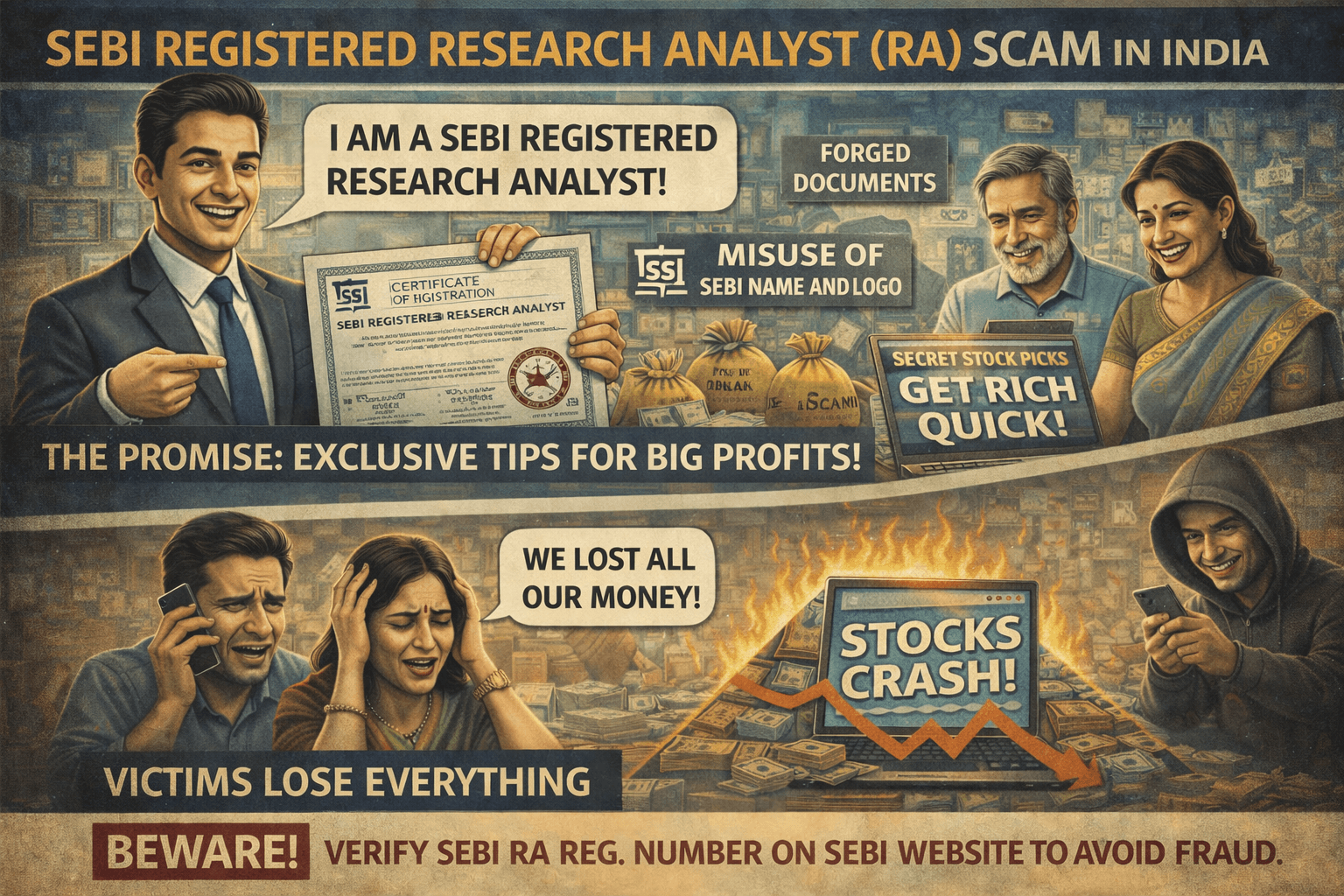
How It Works, Psychological Tricks, and How to Stay Protected
As online trading and digital investment platforms continue to grow in India, so does the number of financial frauds targeting retail investors. One of the most dangerous and rapidly spreading scams is the Research Analyst (RA) scam.
This scam is carefully designed to build trust, manipulate emotions, and exploit the desire for quick profits, ultimately leading to significant financial losses.
This guide provides a complete, in-depth understanding of how RA scams operate, the psychology behind them, and how you can protect yourself.
What is a Research Analyst (RA) Scam?
A Research Analyst scam is a type of organized financial fraud where scammers impersonate:
- Stock market experts
- Investment advisors
- SEBI-registered Research Analysts
They approach individuals through:
- WhatsApp groups
- Telegram channels
- Social media platforms
- Unsolicited phone calls
Their goal is simple: Convince you to trust them and eventually transfer money or invest based on their fake advice.
Why RA Scams Are So Effective
RA scams are not random — they are strategically planned. They work because they target:
- 🧠 Greed → Promise of quick and high returns
- 😟 Fear of Missing Out (FOMO) → “Limited-time opportunity”
- 🤝 Trust → Fake identity and professional behavior
- 👥 Social Proof → Fake testimonials, profit screenshots, and group activity that create the illusion that others are consistently earning
Step-by-Step Breakdown of the RA Scam
Understanding how a Research Analyst (RA) scam works step-by-step is the best way to protect yourself. These scams are not random — they follow a structured process designed to slowly build trust and then exploit it.
1. Unsolicited Approach (The First Contact)
The scam begins when you receive a message, call, or social media request from an unknown number.
Common messages include:
- “Join our free stock market tips group”
- “Earn daily 3–5% profit with expert guidance”
- “Limited seats for premium trading calls”
These messages are carefully designed to:
- Grab your attention
- Trigger curiosity
- Make you feel like you are getting a special opportunity
At this stage, the scammer does not ask for money. Their only goal is to start a conversation and pull you into their network. 2. Attraction Through Free Tips (Building Initial Trust)
Once you respond, you are usually:
- Added to a WhatsApp or Telegram group
- Given a few free stock recommendations
Some of these tips may actually work and give small profits.
Why this works:
- It creates instant credibility
- You start believing the scammer has real expertise
- Your hesitation begins to reduce
This step is crucial because it converts a stranger into a “trusted advisor” in your mind.
3. Relationship & Trust Building Phase
Now the scammer focuses on building a deeper connection.
They may:
- Talk politely and professionally
- Share market news and basic knowledge
- Act like a mentor or guide
They may also:
- Respond quickly to your questions
- Show concern about your “financial growth”
Psychological impact:
- You begin to trust them emotionally
- You feel they are helping you, not selling something
This is where the scam becomes dangerous —because trust replaces logic.
4. Premium Membership Trap.
After gaining your confidence, the scammer introduces a paid service.
They may say:
- “You are eligible for our VIP group”
- “Premium members get high-profit opportunities”
- “Free group is limited — real profits are in premium”
They charge a fee, usually:₹5,000 to ₹50,000 (or even more)
Why victims agree:
- They have already seen small profits
- They don’t want to miss bigger opportunities
- They feel this is a “logical next step”
This is the first point where you become financially involved in the scam.
5. Fake Ecosystem & Social Proof Creation
Inside the premium group, a fake environment is created to influence you.
You will see:
- Screenshots of huge profits
- Messages like:
- “Made ₹1 lakh today ”
- “Sir’s accuracy is 100%”
Important truth:
- Most of these users are fake or controlled by scammers
- Screenshots are edited or manipulated
Psychological effect:
- You feel “everyone is earning except me”
- You gain more confidence in the scammer
- Your doubt completely disappears
This step uses peer pressure and social proof to push you further.
6. Urgency & High-Profit Opportunity Trap
Now comes the most critical phase.
Scammers introduce:
- “Special trading calls”
- “Operator-based stocks”
- “Insider information”
They create urgency by saying:
- “Last chance to enter”
- “Stock will hit upper circuit today”
- “Only premium members can access this”
What happens here:
- You stop thinking logically
- You feel pressured to act quickly
- You fear missing out on a big profit
This is where victims make hasty and emotional decisions.
7. Large Investment Extraction
At this stage, scammers push you to invest bigger amounts.
They may:
- Ask you to invest ₹50,000, ₹1 lakh, or more
- Suggest increasing your capital for “maximum profit”
- Sometimes even ask for direct bank transfers
Why victims invest more:
- Previous trust and group influence
- Fear of missing a big opportunity
- Belief that “this time profit will be huge”
This is the stage where maximum financial damage occurs.
8. Exit Phase (Scammer Disappears)
Once the scammer has extracted enough money:
- The stock tips fail or cause heavy losses
- The scammer stops responding
- You may be removed from the group or blocked
In some cases:
- They may give excuses initially (market crash, technical issue)
- But eventually disappear completely
Final result:
- Victim loses money
- No recovery or support
- Scammer moves on to new targets
Advanced Warning Signs (Deep Red Flags)
Beyond basic signs, watch out for:
- Use of fake SEBI registration numbers
- Slightly modified company names to look official
- Screenshots that look “too perfect”
- Overuse of urgency and emotional pressure
- Advice that avoids proper risk explanation
- Requests to install unknown apps or platforms
Psychological Manipulation Techniques Used
RA scammers are experts in human behavior. They use:
1. Authority Bias
They present themselves as experts to gain automatic trust.
2. Social Proof
Fake group activity makes you believe “everyone is earning”.
3. Commitment Bias
Once you pay a small fee, you feel committed to continue.
4. FOMO (Fear of Missing Out)
You are made to feel you will lose a big opportunity.
5. Gradual Escalation
They start small and slowly push you into bigger risks.
How to Protect Yourself (Practical Safety Measures)
- Always verify analysts through official regulatory platforms
- Never trust unsolicited financial advice
- Avoid joining unknown investment groups
- Do not share personal, banking, or trading details
- Do not transfer money to personal accounts
- Take time before making any financial decision
- Use only trusted and regulated brokers
What To Do If You Become a Victim
If you suspect fraud:
- 🌐 Report at:https://scores.sebi.gov.in/ & https://smartodr.in/login
- 📸 Keep evidence (screenshots, chats, transaction details)Acting quickly increases the chances of recovery.
How to Identify That It Is Not a Scam
Before trusting any Research Analyst or financial advisor, it is important to verify their authenticity. The following checks can help you determine whether an offer is genuine or a potential scam:
- Verify SEBI Registration Always check whether the analyst is officially registered with SEBI through the official website. Do not rely on screenshots or documents shared on WhatsApp.
- No Guaranteed Returns In the stock market, no one can guarantee fixed or risk-free profits. Any claim of “assured returns” is a strong warning sign.
- Avoid Unsolicited Contact Genuine analysts usually do not randomly message or call unknown individuals offering investment opportunities.
- Check for Transparency Authentic advisors clearly explain risks, strategies, and do not hide important information.
- No Pressure or Urgency Scammers often create urgency like “limited time offer” or “last chance.” Legitimate professionals allow time for decision-making.
- Payment Safety Avoid transferring money to personal bank accounts. Registered entities use official and secure payment channels.
- Independent Verification Always cross-check information from multiple reliable sources before making any financial decision. formation from multiple reliable sources before making any financial decision.
Being cautious and verifying information is the best way to protect yourself from financial scams.
If you have experienced any type of scam, you can reach out to Scam Free India. Our team is here to guide and support you.
Written by
admin