How Fraudsters Pretend to Be Police, CBI, or Cyber Crime Officers to Extort Money
Introduction
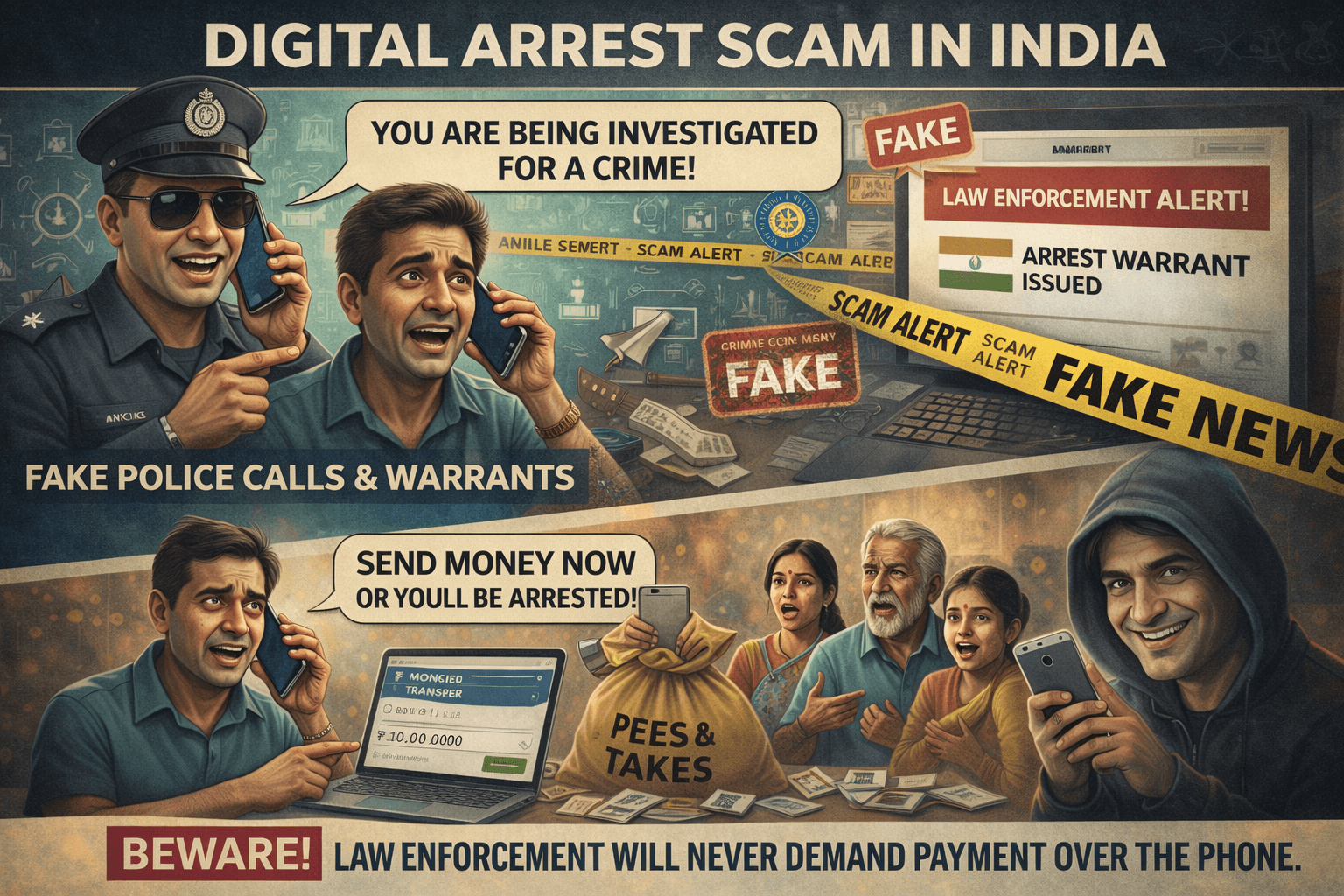
In recent years, one of the most dangerous and fast-growing cyber frauds in India is known as the Digital Arrest Scam. In this type of scam, fraudsters pretend to be police officers, CBI officers, cyber crime officers, customs officers, or bank officials and accuse the victim of being involved in illegal activities such as money laundering, drug parcels, illegal bank accounts, SIM card fraud, or international transactions.
They then threaten the victim with arrest, jail, court case, passport block, bank account freeze, or police action. The victim is told that they are under “Digital Arrest”, meaning they must stay on a video call and cannot contact anyone until the investigation is completed. During this time, the scammers pressure the victim to transfer money for “verification”, “security deposit”, or “case settlement”.
Many people lose lakhs of rupees because they panic and believe the scammers are real officers.
This article explains how digital arrest scams work, the psychology behind them, warning signs, and how to protect yourself.
What is a Digital Arrest Scam?
A Digital Arrest Scam is a cyber fraud where scammers:
- Pretend to be police, CBI, cyber crime, RBI, customs, or telecom officials
- Accuse the victim of involvement in a crime
- Threaten arrest or legal action
- Force the victim to stay on video call
- Ask the victim to transfer money for investigation or verification
- Keep the victim isolated and scared
- Take money through bank transfer, UPI, or crypto
Important:
There is no such legal thing as “Digital Arrest”.
Police cannot arrest someone on a video call.
How Digital Arrest Scam Usually Starts
The scam usually begins with a phone call from someone claiming to be from:
- Police Department
- Cyber Crime Department
- CBI
- Enforcement Directorate
- RBI
- Customs Department
- Telecom Department
- Courier Company
- Bank Fraud Department
They speak very seriously and professionally.
Common starting statements:
- A parcel in your name has been caught containing illegal items
- Your Aadhaar card is linked to illegal bank accounts
- Your SIM card is involved in fraud
- Your bank account is used for money laundering
- There is a case registered against you
- Your account will be frozen
- You will be arrested
- A warrant is issued in your name
The victim becomes scared and confused.
The Video Call and Fake Police Setup
After the initial call, scammers often ask the victim to join a video call on Skype, WhatsApp, or Zoom.
On the video call, they may show:
- A person in police uniform
- Fake police station background
- Fake government office background
- Fake ID cards
- Fake arrest warrant
- Fake FIR document
- Fake court document
- Fake RBI letter
- Fake investigation papers
This makes the scam look very real.
They then say:
“You are under Digital Arrest. You cannot disconnect the call. You cannot contact anyone. This is a confidential investigation.”
This is done to isolate the victim so they cannot verify the truth.
The Investigation Drama
Scammers then conduct a fake investigation process:
- Ask Aadhaar details
- Ask bank account details
- Ask transaction details
- Ask income details
- Ask family details
- Ask employment details
- Ask to show bank balance
- Ask to share screen
- Ask to install apps like AnyDesk or screen sharing apps
They try to collect financial information and create fear.
They may say:
- Your money is illegal
- Your account will be frozen
- You will be arrested today
- Police team is coming to your house
- Court case will be filed
- Passport will be blocked
- You will go to jail for 7 years
The victim becomes very scared and panics.
Money Transfer Stage – “Verification” or “Security Deposit”
After creating fear, scammers say:
“To verify that your money is legal, you must transfer money to a government account temporarily. After verification, the money will be returned.”
They call this:
- Security deposit
- Account verification
- Fund verification
- RBI verification
- Case settlement
- Investigation charges
- Temporary transfer
- Safe account transfer
They ask the victim to transfer money via:
- Bank transfer
- UPI
- RTGS/NEFT
- Crypto transfer
- Gift cards (in some cases)
Once money is transferred, scammers either:
- Ask for more money
- Continue fake investigation
- Stop responding and disappear
Why Digital Arrest Scams Work – Psychology
These scams are very dangerous because they use fear instead of greed.
Psychological tactics used:
- Fear of police and arrest
- Authority (Police, CBI, RBI names)
- Urgency (Immediate action required)
- Isolation (Do not talk to anyone)
- Confusion (Legal language and documents)
- Continuous pressure (Stay on call)
- Threat (Jail, case, arrest)
- Hope (Money will be returned after verification)
Victims panic and stop thinking logically.
Major Warning Signs of Digital Arrest Scam
Always be careful if:
- Someone calls claiming to be police or CBI
- They ask for money to avoid arrest
- They ask you to stay on video call
- They say you are under digital arrest
- They ask you not to talk to anyone
- They ask for bank details or OTP
- They ask to install screen sharing apps
- They ask to transfer money for verification
- They threaten immediate arrest
- They show documents on WhatsApp
- They ask secrecy
- They ask money in personal accounts
Police never ask money to avoid arrest.
Important Things Everyone Must Know
- Police do not investigate cases on WhatsApp video calls
- Police do not ask money for verification
- Police do not ask money to avoid arrest
- Police do not conduct digital arrest
- Police do not ask you to keep camera on for hours
- Government agencies do not ask money via UPI
- Courts do not settle cases via WhatsApp
- RBI never calls for account verification
If someone is asking money in the name of police or investigation, it is almost certainly a scam.
How to Protect Yourself from Digital Arrest Scam
To stay safe:
- Do not panic if someone claims to be police
- Disconnect the call immediately
- Never transfer money for verification
- Never share OTP or bank details
- Never install screen sharing apps
- Do not stay on video call under pressure
- Contact your local police station directly
- Talk to family or friends before taking action
- Verify any legal notice from official sources
- Remember that digital arrest does not exist
What To Do If You Are a Victim of Digital Arrest Scam
If you already transferred money:
- Immediately inform your bank
- Call 1930 (Cyber Crime Helpline)
- File complaint on Cyber Crime Portal
https://cybercrime.gov.in - Save call recordings and screenshots
- Save bank transaction details
- Save phone numbers used by scammers
- Report the incident as soon as possible
- Early reporting increases chances of fund recovery
Final Conclusion
Digital arrest scams are dangerous because they use fear, authority, and pressure to control the victim. Scammers pretend to be powerful government officials and create panic so that the victim does not think logically and transfers money quickly.
Always remember this simple rule:
No police officer will ever ask money to avoid arrest.
There is no such thing as digital arrest.
If someone asks money in the name of police or investigation, it is a scam.
“Police kabhi paise lekar case band nahi karti,
jo paise maange vo police nahi scammer hota hai.”
Stay aware, stay calm, and always verify before sending money.
Written by
admin