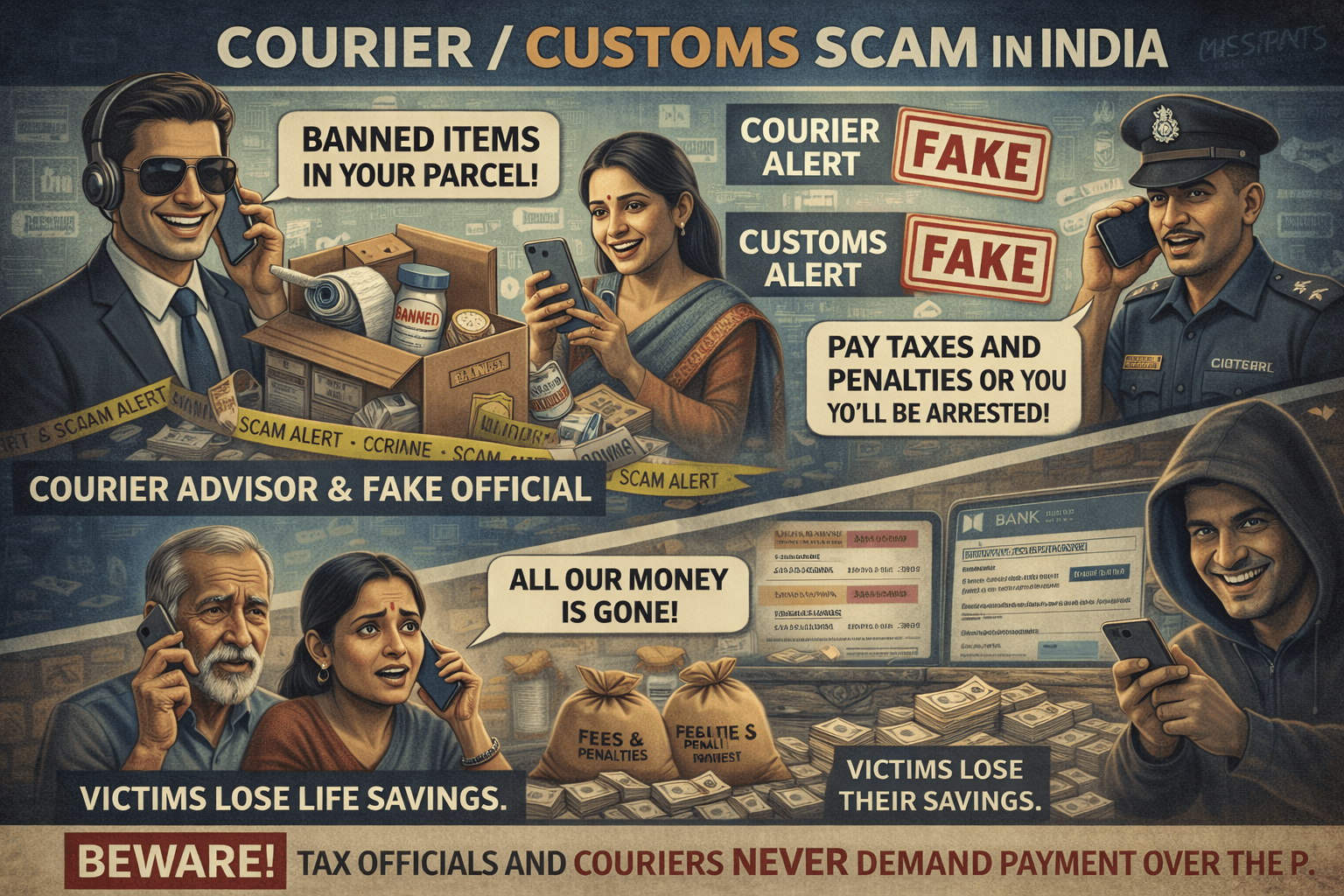
Complete Guide – How Parcel, Customs, and Fake Legal Threat Scams Work
Introduction
Courier and Customs scams are one of the fastest-growing cyber frauds in India. In this scam, fraudsters contact victims and inform them that a parcel in their name has been stopped by customs, police, or a courier company. The parcel is said to contain illegal items, foreign currency, gold, passports, SIM cards, drugs, or suspicious documents. In some cases, scammers claim that the parcel contains expensive gifts or money sent from abroad.
After this, the victim is asked to pay customs duty, clearance charges, courier fees, penalty charges, verification fees, or legal settlement charges. Sometimes the scammers also threaten arrest, police case, bank account freeze, or passport block, which turns the scam into a digital arrest type fraud.
People lose money in these scams because either they believe they are receiving a valuable parcel or they panic after hearing that illegal items were found in a parcel in their name.
This article explains in detail how courier and customs scams work, how scammers trap victims, the psychology behind the scam, warning signs, and how to stay safe.
Understanding the Courier / Customs Scam
Courier scams usually work in two main ways:
- Gift Parcel / Foreign Parcel Scam
- Illegal Parcel / Police Case Scam
Both scams follow similar patterns but use different emotions to trap victims.
- Gift parcel scam uses excitement and greed
- Illegal parcel scam uses fear and panic
In both cases, the final goal is the same — to make the victim transfer money.
Type 1 – Gift Parcel / Foreign Parcel Scam
In this scam, the victim is told that someone from abroad has sent them a parcel containing expensive items such as:
- Gold jewellery
- Cash in foreign currency
- iPhone or electronics
- Expensive gifts
- Lottery prize parcel
- Foreign currency
- Luxury items
- Gift box
- Jewellery parcel
Sometimes scammers pretend to be:
- Online friend from foreign country
- Army officer posted abroad
- Business person
- NRI friend
- Online dating partner
- Lottery company
- Charity organization
They say the parcel has reached India but is stuck at customs and needs clearance.
Then they ask for:
- Customs duty
- Clearance charges
- Courier charges
- Insurance charges
- Airport charges
- Storage charges
- Delivery charges
- Currency conversion charges
- Anti-terror clearance fee
- Documentation charges
Victims keep paying these charges hoping they will receive the parcel, but no parcel ever exists.
Type 2 – Illegal Parcel / Police Case Scam
This is more dangerous and is now very common.
In this scam, the victim receives a call saying:
- A parcel in your name contains drugs
- A parcel contains fake passports
- A parcel contains illegal currency
- A parcel contains ATM cards
- A parcel contains SIM cards
- A parcel contains money laundering documents
- A parcel is linked to a criminal case
Then the call is transferred to:
- Police officer
- Cyber crime officer
- CBI officer
- Customs officer
- Narcotics officer
They threaten:
- Arrest
- Police case
- Court case
- Bank account freeze
- Passport block
- Digital arrest
- Investigation
- Jail
Then they ask money for:
- Case settlement
- Verification charges
- Security deposit
- Investigation charges
- Bail amount
- Penalty charges
- Account verification
- Fund verification
This is often combined with Digital Arrest Scam.
Step-by-Step Courier / Customs Scam Process
Step 1 – Parcel Information Call
Scammer calls and says:
“A parcel in your name has been stopped by customs/courier/police.”
They ask for confirmation:
- Name
- Phone number
- Aadhaar number
- Address
This makes the scam look real and official.
Step 2 – Parcel Details Story
Scammer then tells what is inside the parcel:
- Gold
- Cash
- Drugs
- Passport
- Electronics
- Foreign currency
- Illegal documents
- ATM cards
- SIM cards
Victim becomes either:
- Excited (gift parcel)
- Scared (illegal parcel)
This emotional reaction is exactly what scammers want.
Step 3 – Charges or Legal Threat
Scammers then say:
- Pay customs charges to release parcel
- Pay penalty to avoid police case
- Pay verification amount
- Pay security deposit
- Pay clearance charges
- Pay investigation charges
- Pay legal charges
Money is asked through:
- Bank transfer
- UPI
- Wallet
- Crypto
- Gift cards
This is a major red flag.
Step 4 – More Charges Trap
After the first payment, scammers ask for more charges:
- Insurance charges
- Tax charges
- Courier charges
- Storage charges
- Delivery charges
- Legal charges
- Verification charges
- Clearance charges again
- GST charges
- Account verification charges
Victim keeps paying because they believe:
“I already paid so much, now I must finish the process.”
This is called Sunk Cost Trap.
Step 5 – Final Stage – Scammer Disappears
After taking enough money:
- Calls stop
- WhatsApp blocked
- Email stops
- No parcel delivered
- Money lost
Victim realizes it was a scam.
Psychology Behind Courier / Customs Scams
These scams work because scammers use human emotions and psychology.
1. Fear
Illegal parcel, police case, arrest.
2. Excitement
Foreign gift, gold parcel, cash parcel.
3. Urgency
Parcel will be returned or destroyed if not cleared.
4. Authority
Scammers pretend to be customs officers, police, courier officials.
5. Pressure
Immediate payment required.
6. Confusion
They use legal and customs terms to confuse the victim.
7. Isolation
Sometimes they tell victims not to talk to anyone.
Victims panic and transfer money without verifying.
Major Warning Signs of Courier / Customs Scam
Always be careful if:
- Someone calls about parcel you never ordered
- Parcel contains gold or cash from abroad
- Customs asking money through UPI
- Police asking money to avoid case
- Parcel release fee asked
- Clearance charges asked
- Unknown courier asking payment
- Parcel story involving drugs or illegal items
- Calls transferred between departments
- Asked to keep call confidential
- Asked to stay on video call
- Asked to transfer money immediately
Government departments do not ask money on phone calls.
Important Things Everyone Must Know
Very important points:
- Customs does not call and ask money on phone
- Police does not ask money to avoid arrest
- Courier companies do not ask customs duty via UPI
- Government departments do not use WhatsApp for legal notices
- Police does not conduct investigation on video calls
- No one can arrest you over a phone call
- If a parcel contains illegal items, police will visit directly, not ask money
- Customs duty is paid through official government portals, not personal accounts
How to Protect Yourself from Courier / Customs Scams
To stay safe:
- Do not panic if someone mentions police or customs
- Verify courier company directly
- Do not transfer money to unknown accounts
- Do not share OTP or bank details
- Disconnect suspicious calls
- Contact local police station if threatened
- Do not believe foreign gift parcel stories
- Do not pay customs charges to individuals
- Always verify before making payment
- Talk to family before making decisions
- Search phone number online before trusting
- Remember that scammers create fear and urgency
Golden Rule:
If someone asks money to release a parcel or to avoid a police case, it is most likely a scam.
What To Do If You Are a Victim of Courier / Customs Scam
If you already paid money:
- Inform your bank immediately
- Call Cyber Crime Helpline – 1930
- File complaint on Cyber Crime Portal
https://cybercrime.gov.in - Save all call recordings and messages
- Save payment receipts
- Save phone numbers used
- Save bank account details used
- Report immediately for fund recovery
Early reporting increases chances of recovery.
Final Conclusion
Courier and customs scams are dangerous because they use both excitement and fear to trap victims. Fraudsters pretend to be courier companies, customs officers, or police officers and pressure victims into transferring money for parcel release or case settlement.
Always remember these simple rules:
- If you did not order a parcel, be careful.
- Customs and police never ask money through phone calls or UPI.
- Government departments do not settle cases through WhatsApp.
- If someone asks for money to release a parcel, it is most likely a scam.
Final Line:
“Jo parcel aapne mangwaya hi nahi, usko release karne ke liye paise dena scam ka sabse common trap hai.”
Written by
admin